 Empowering Minds Through Education & Coaching in Programming, Math, Logic, Sport, Communication…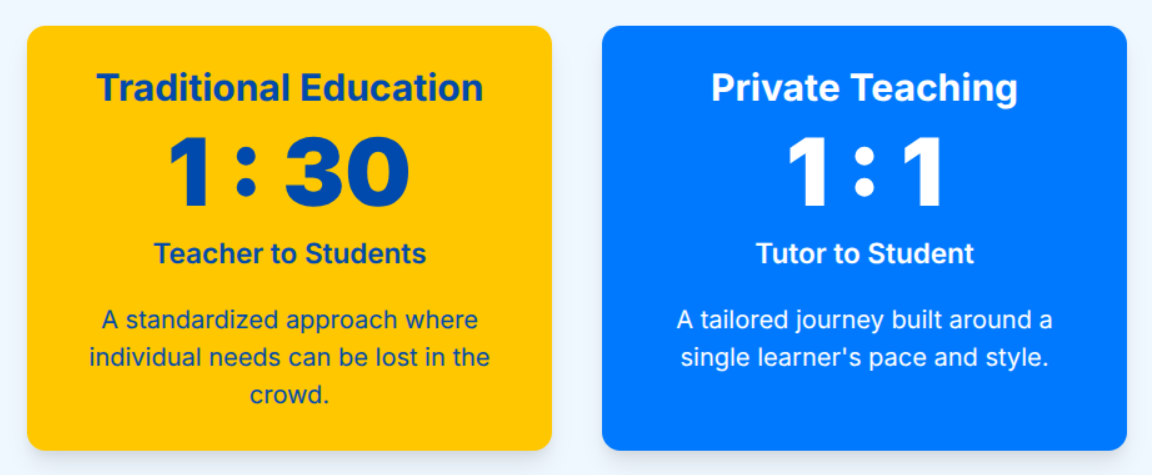
How Private Education Fosters True Success
The core advantage of private teaching (tutoring, individualized coaching, etc.) lies in its ability to be tailored to the individual learner.
1. Personalized Attention and Pace
In a traditional classroom, a single teacher is responsible for a large group of students, making it challenging to address each student’s unique learning style, pace, and specific difficulties. Private teaching provides one-on-one or small-group instruction, allowing the educator to fully focus on the individual.
Examples:
- A child struggling with math concepts in a class of 30 might fall behind because the teacher can’t dedicate enough time to their specific questions. With a private tutor, the tutor can spend as much time as needed explaining a single concept (e.g., fractions) until the child truly grasps it, using various methods until one clicks.
- Imagine a kid who grasps algebra concepts quickly but struggles with geometry. In a traditional class, they’d spend fixed time on both, potentially disengaging during algebra or feeling overwhelmed by geometry. A private math tutor can spend 80% of the time on geometry, using visual aids and hands-on problems that resonate with the child, and quickly review algebra, allowing them to truly master both at their own speed.
- An adult learning a new language for professional reasons might have specific vocabulary needs related to their industry. A private language tutor can design lessons around that vocabulary and practice real-world scenarios relevant to their job, rather than following a generic textbook.
- Someone learning a complex software like Adobe Photoshop might be a visual learner. A group course might involve lengthy lectures. A private instructor can share their screen, demonstrate actions, and then immediately let you try it yourselves, correcting mistakes in real-time, repeating specific steps until they’re intuitive, and focusing only on the tools relevant to your specific projects.
2. Targeted Instruction and Gap Filling
Private teachers can quickly identify and address specific knowledge gaps or areas of weakness. They can also accelerate learning in areas where the student is strong, optimizing their progress.
Examples:
- A student consistently making errors in essay writing might be struggling with sentence structure, paragraph organization or thesis development. A private English tutor can pinpoint the exact issue and create targeted exercises to improve that specific skill, rather than just assigning more essays.
- Somebody preparing for a certification exam might be proficient in most topics but weak in one particular section. A private instructor can dedicate sessions solely to that difficult section, providing focused practice and explanations, without having to cover material you already know.
3. Safe & Comfortable Learning Environment
Many individuals, both children and adults, feel intimidated or anxious in large group settings, which can hinder their willingness to ask questions or participate. Private teaching offers a judgment-free, one-on-one space.
Examples:
- Social Anxiety: A kid with social anxiety might clam up in a classroom, afraid to ask questions even when confused. With a kind, private tutor, they feel safe to express their difficulties, ask “silly” questions and truly engage without peer pressure. This builds confidence that can later transfer to other settings!
- New Skill Acquisition: An adult learning a new, complex skill, say, playing a musical instrument, might feel self-conscious making mistakes in front of others. A private music teacher creates a supportive environment where they can freely experiment, stumble and refine their technique without embarrassment, fostering faster progress.
4. Customized Learning Styles and Methods
Every individual learns differently (visual, auditory, kinesthetic, etc.). Private teachers can adapt their teaching methods to match the student’s preferred learning style, making the process more effective and engaging.
Examples:
- If your child is a kinesthetic learner then he/she might struggle with abstract math concepts taught through lectures. A private tutor could use manipulatives, games or hands-on activities to make the concepts tangible and understandable.
- When learning a new software program you prefer learning by doing rather than just watching demonstrations. A private coach could guide you through real-time projects, allowing to learn by actively using the software.
5. Flexible Scheduling and Location
Private teaching offers greater flexibility in terms of scheduling and location, which is particularly beneficial for individuals with busy lives or specific needs.
Examples:
- A child involved in extracurricular activities might find it difficult to attend fixed after-school programs. Private tutoring can be scheduled at times that fit their schedule, even online from home.
- A working professional can arrange private sessions during lunch breaks, evenings, or weekends, either in person or virtually, making it easier to integrate learning into their busy life.
6. Mentorship and Motivation
A private teacher often develops a strong rapport with their student, becoming a mentor & motivator. This personalized relationship can significantly influence a student’s attitude towards learning and their overall academic or professional growth.
Examples:
- A struggling student might become disengaged with a subject they dislike. A passionate private tutor can reignite their interest by making the subject relatable and showing them their progress, fostering a love for learning.
- Someone who is pursuing a career change might need not only skill development but also encouragement and guidance. A private coach can offer both, helping to stay motivated and navigate challenges.
7. Immediate, Targeted Feedback and Correction
In a traditional setting, a teacher’s feedback might be delayed, generic or infrequent due to the large number of students. Private teaching allows for instant feedback on mistakes, misconceptions, and progress, preventing bad habits from forming and solidifying understanding.
Examples:
- Writing Skills: A kid writing an essay in a class might get a grade and a few comments a week later. With a private writing coach, as soon as the kid writes a confusing sentence or an unsupporting paragraph, the tutor can immediately interject, “What were you trying to say here? How could you make that clearer?” This iterative, real-time correction builds writing proficiency far more quickly!
- Public Speaking: When practicing a presentation in a workshop you might get general advice from the group. A private public speaking coach can observe their posture, eye contact, vocal fillers and specific phrasing in real-time. They can stop your mid-sentence, provide a precise correction (“Your voice dropped at the end there, try projecting more”), and have you immediately re-do that section until it’s perfected.
8. Increased Confidence and Reduced Anxiety
In a private setting, students often feel more comfortable asking questions, making mistakes, and expressing confusion without fear of judgment from peers. This fosters a safe learning environment, boosting confidence and reducing anxiety.
Examples:
- A shy child might hesitate to ask questions in a large classroom, leading to persistent confusion. In a one-on-one session, they are more likely to open up and seek clarification, leading to a deeper understanding and improved self-esteem.
- An adult returning to education after a long break might feel intimidated by a formal classroom setting. A private tutor can provide a supportive and non-judgmental space, helping them regain confidence and build foundational skills.
In essence private teaching offers an intensive, highly efficient & deeply personalized pathway to mastery and confidence, making it a superior choice for those seeking optimized and best learning outcomes.